Showing posts with label polymers. Show all posts

Friday, March 6, 2020

Corrosion of Snails in H2CO3 Medium and Their Protection by Aloe Vera| Lupine Publishers

 Lupine Publishers| Material Science Journals

Abstract

Snails are beautiful creation of nature. They occur in rivers as well as ponds. But these sources of water are contaminated by effluents, pollutants, acid rain, particulates, biological wastes etc. They can change the pH of water. Water is absorber of carbon dioxide and it converts carbon dioxide into carbonic. Other above-mentioned wastes also increase the concentration of H+ ions in water. They produce hostile environment for snails. The outer part of snails is made of CaCO3. It produces chemical reaction in acidic medium and corrosion reaction is accelerated thus deterioration starts on the surface of snails. This medium their survival becomes miserable. For this work corrosion of snails study in the pH values of water is 6.5 in H2CO3 environment. The corrosion rates of snails were calculated by gravimetric methods and potentiostat technique. Aloe Vera was used for corrosion protection in acidic medium. The surface adsorption phenomenon was studied by Lungmuir isotherm. Aloe Vera formed thin surface film on the interface of snails which adhered with chemical bonding. It confirmed by activation energy, heat of adsorption, free energy, enthalpy and entropy. The results of surface coverage area and inhibitors efficiency were indicated that Aloe Vera developed strong protective barrier in acidic medium.
Keywords: Corrosion; Snails; Aloe vera; Carbonic acid; Potentiostat; Thin film formation

Introduction

Corrosion occurs in living organisms [1]. The animals’ outer layer is created by calcium carbonate [2] to corrode in acidic environment. Corrosive substances interact with living organism [3] to produce corrosion cell which is exhibited autoredox with snails [4] and disintegrated their outer layers. It observed that carbon dioxide [5,6] reacts with water to form carbonic which produce hostile environment [7] for snails and [8] Ocean water [9] is major absorber of carbon dioxide to change pH. Carbonic acid interacts with snails to exhibit chemical thus calcification [10] starts on their surface. The oxides of Sulphur [11] dissolve in water to produce sulphrous and sulphuric acid. These acids produce corroding [12] effect with snails. Oxides of nitrogen [13] absorb water to form nitrous and nitric acids and they generate corrosive environment for molluscs [14] Acid rain [15] can change pH of water and produce acidic medium for snails. Industrial wastes and human wastes contaminate water sources and alter the pH values of water in this way it makes water corrosive for snails and molluscs. The temperature [16] of the earth is increasing due to global warming thus water sources temperature is also increased and snails [17] undergo corrosion reaction. Various types of techniques use for corrosion protection [18] like anodic and cathodic protection, galvanization and electroplating, dipping [19] anodization, spray, nanocoating and inhibitors action. Aloe Vera is used for skin corrosion protection in acidic environment. Snails’ corrosion [20] can be control by inhibitor action of Aloe Vera in above mentioned environment. Aloe Vera form a thin barrier on the surface of snails and it is confirmed by activation energy, heat of adsorption, free energy, enthalpy and entropy and these thermal parameters results is noticed that Aloe Vera has good inhibition properties in acidic medium. It forms complex barrier on the surface of snails.

Experimental

Snails dipped into carbonic acid solution which pH value was 6.2. The corrosion rates of snails were determined by gravimetric method at mentioned periods 1,2,3,4 and 5 years at 288,298,303,308 and 3130K temperatures without use of Aloe Vera. Aloe Vera was used as inhibitor in carbonic acid medium and the calculated of corrosion rate of snails above mentioned years and temperatures at 50, 60, 70, 80 and 90M concentrations. Potentiostat 324 model used to determine the corrosion potential, corrosion current density at different temperatures and concentrations. These results were obtained by application of calomel electrode as auxiliary electrode and Pt reference electrode. The snail kept between these electrode and external current passed through without and with inhibitor. The results were noticed that anodic current decreased and cathodic current increased by the use of Aloe Vera. The gravimetric method corrosion rate results were approximated to potentiostat corrosion obtained results.

Results and Discussion

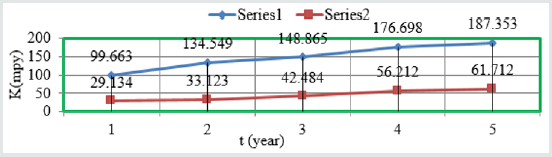
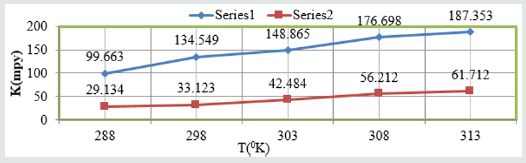
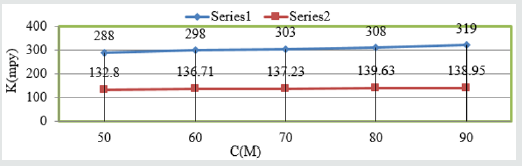
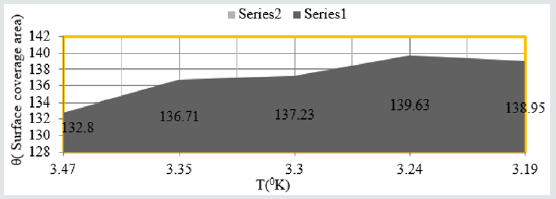
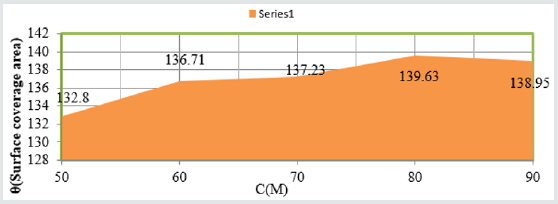
The corrosion rate of snails were determined by without and with Aloe Vera in mpy (miles per year) at different temperatures, concentrations and times in years by the use of formula K=534XΔW/D A t (where ΔW is weight loss in g, A is area in sq inch, t is immersion time in year). The dipping times were 1,2,3,4 and 5 years and temperatures are 288,298,303,308 and 3130K without inhibitors corrosion rate of snail is calculated and their values were recorded in Table 1. The addition of Aloe Vera in carbonic acid medium and corrosion rate of snail calculated at 288,298,303,308 and 3130K temperatures and 50, 60, 70, 80 and 90M concentrations and its values were mentioned in Table 1. It observed that without action of inhibitor corrosion rate of snail increased as duration of times and temperatures were increased and, but its values were decreased after addition of Aloe Vera such types of trends noticed in Figure 1 K Vs t, Figure 2 K Vs T and Figure 3 K Vs C. The surface coverage area and inhibitor efficiency were calculated by formula θ= (1-K/Ko) and %IE= (1-K/Ko) X100 (where Ko corrosion rate without inhibitor and K corrosion rate with inhibitor) and their values were given in Table 2. The surface coverage area and inhibitor efficiency were calculated by formula θ= (1-K/Ko) and their values were given in Table 2. The results of Table 2 were shown that surface coverage area and percentage inhibitors efficiency were enhanced when inhibitors added at different temperatures and concentrations as per year. Such types of trends were noticed in Figure 4 θ Vs T and Figure 5 θ Vs C.
Figure 1: K Vs t for snails at different years.
Lupinepublishers-openaccess-material-science-journal
Figure 2: K Vs T for snails at different tempertaures.
Lupinepublishers-openaccess-material-science-journal
Figure 3: K Vs C for snails at concentations.
Lupinepublishers-openaccess-material-science-journal
Figure 4: θ Vs T for snails in Aloe Vera.
Lupinepublishers-openaccess-material-science-journal
Figure 5: θ Vs C for snails in Aloe Vera.
Lupinepublishers-openaccess-material-science-journal
Table 1: Corrosion rate of snail absence and presence of Aloe Vera in H2CO3.

Lupinepublishers-openaccess-material-science-journal
Table 2: Surface coverage area develop by Aloe Vera on the snails in H2CO3.

Lupinepublishers-openaccess-material-science-journal
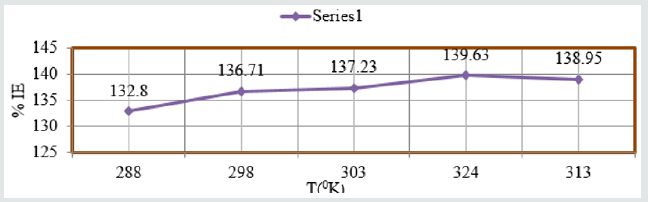
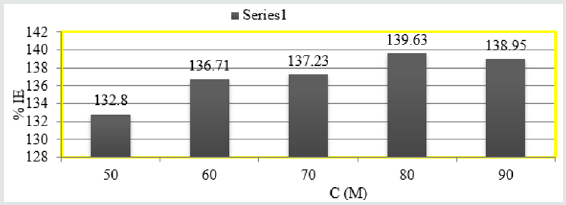
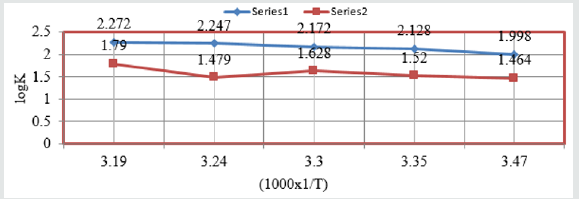
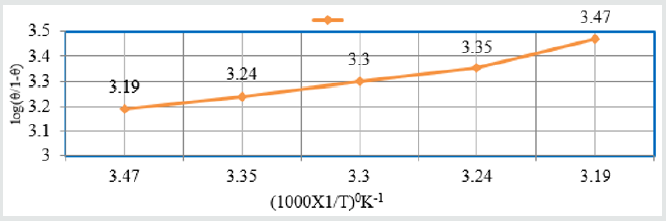
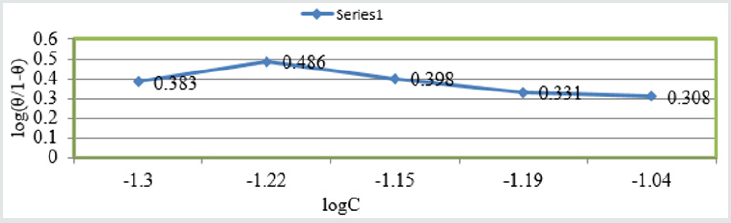
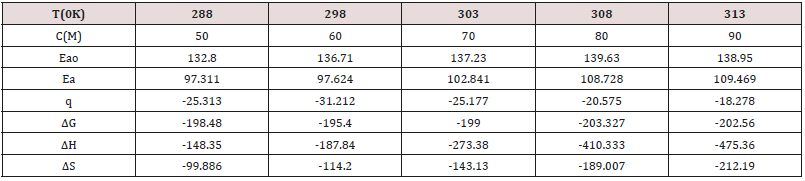
The percentage inhibitors of Aloe Vera at different temperatures and concentrations as one-year interval were calculated by %IE= (1-K/Ko) X100 (where Ko corrosion rate without inhibitor and K corrosion rate with inhibitor) and the values were written in Table 3. The results of Table 3 were depicted that percentage inhibitors efficiency were increased as temperatures and concentration were enhanced. Such types of trends also observed in Figure 6 %IE Vs T and Figure 7 %IE Vs C. Surface adsorption phenomenon was studied by activation energy, heat of adsorption, free energy, enthalpy and entropy. Activation energy was determined by formula K=A e-Ea/RT (where K is corrosion rate, Ea is activation energy and T is absolute temperature without and with action of Aloe Vera at different temperatures and concentrations and their values were recorded in Table 4. It observed that activation energy increased without inhibitors but its values decreased after addition of inhibitors. These results were shown in Table 4 which indicated that inhibitors adhered on snails by chemical bonding and their values were obtained by Figure 8 plotted logK Vs 1/T. Heat of adsorption values were found to be negative which indicated that Aloe Vera was shown an exothermic reaction in H2CO3 medium. It adsorbed on the surface of snail by chemical bonding. The values of heat of adsorption were determined by Langmuir isotherm log(θ/1-θ) = logA +logC-q/2.303RT and Figure 9 plotted log(θ/1-θ) Vs1/T and Figure10 plotted against log(θ/1-θ) Vs logC and their values were recorded in Table 4.
Figure 6: %IE Vs T for snails in Aloe Vera.
Lupinepublishers-openaccess-material-science-journal
Figure 7: %IE Vs C for snails in Aloe Vera.
Lupinepublishers-openaccess-material-science-journal
Figure 8: logK Vs 1/T for snails in Aloe Vera.
Lupinepublishers-openaccess-material-science-journal
Figure 9: log(θ/1-θ) Vs 1/T for snails in Aloe Vera.
Lupinepublishers-openaccess-material-science-journal
Figure 10: log(θ/1-θ) Vs logC for snails in Aloe Vera.
Lupinepublishers-openaccess-material-science-journal
Table 3: Inhibition efficiency develop by Aloe Vera in H2CO3.

Lupinepublishers-openaccess-material-science-journal
Table 4: Thermal parameters of Aloe Vera with Snails.
Lupinepublishers-openaccess-material-science-journal
Table 5: Potentiostatic results of snails for Aloe Vera.

Lupinepublishers-openaccess-material-science-journal
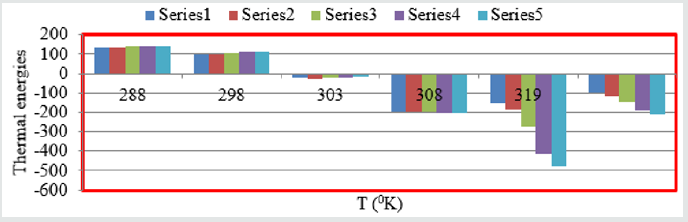
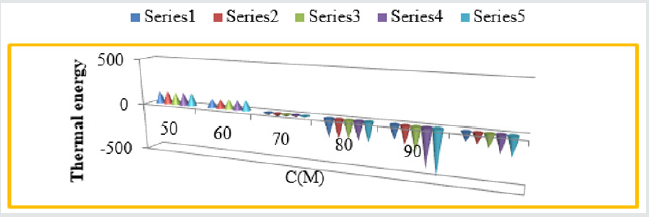
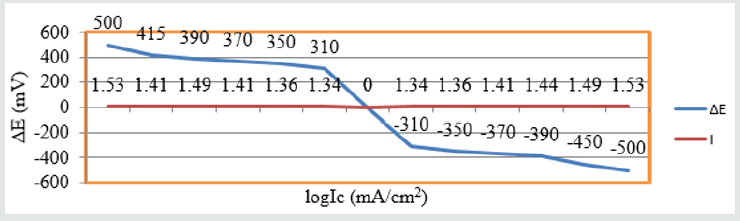
Free energy of inhibitor Aloe Vera was calculated by equation ΔG=2.303 log(33.3K) and their values were given in Table 4. Their values noticed that inhibitor action a chemical reaction because free energy values were negative, and their values mentioned in Table 4. Enthalpy of used inhibitors was determined by transition state equation K=RT/Nh eΔS/R e-ΔH/RT and its values were recorded in Table 4. These values indicated that inhibitor’s Aloe Vera boned with snail by chemical bonding. Entropy of Aloe Vera was determined by equation by ΔG = ΔH – TΔS and their values were mentioned in Table 4. Their values were shown that deposition of Aloe Vera on the surface of snail was an exothermic process. It formed stable barrier on the surface of snail. All five values of thermal parameters plotted against T in Figure 11 and Figure 12 against C. The corrosion potential, corrosion current density and corrosion rate were determined by the equation ΔE/I=1/2.303 βaβc/(βa+βc) and C R(mpy)=0.1288 Ic (mA/cm2) XE/ρ and values were recorded in Table 5. It observed that without inhibitor corrosion potential and corrosion current were decreased but after addition of Aloe Vera corrosion current densities were increased. It also reduced the corrosion potential and corrosion current. The corrosion rate calculated by potentiostat technique and their values were tallied with the corrosion rate determined by gravimetric method. Corrosion potential versus corrosion current density was plotted in Figure 13. This plot indicated that anodic current reduced as addition of inhibitor but cathodic current enhanced Table 5.
Figure 11: Themal energies Vs T for Aloe Vera with Snails.
Lupinepublishers-openaccess-material-science-journal
Figure 12: Thermal energies Vs C for Aloe Vera with snails.
Lupinepublishers-openaccess-material-science-journal
Figure 13: ΔE Vs Ic for snails with Aloe Vera.
Lupinepublishers-openaccess-material-science-journal

Conclusion

Snails’ corrosion occurs due to change the pH of water. Water pH is altered by contamination effluents, industrial polluters, and various types of wastes and acids rain. Snails outer layers are constructed by calcium carbonate. In acidic medium calcification starts on their surface by chemical process. It produces pitting, stress and crevice corrosion. For the protection of such types corrosion Aloe Vera is used as inhibitors. Aloe Vera forms thin film on the surface of snails. The thin film formation is confirmed by thermal parameters like activation energy, heat of adsorption, free energy, enthalpy and entropy. Aloe Vera surface adsorption phenomenon on snails is also satisfied by Langmuir isotherm. Aloe Vera is reduced the concentration of H+ ions and enhance the concentration of oxygen molecules. It is nitrogen containing rich organic compounds which capture H+ ions and less H2 gas is released thus corroding effect of snails suppressed.

Acknowledgment

Author is thankful for UGC-New Delhi, India for providing financial support for this work. I also thank my research team for their collection of data and graph plotting. I am very grateful professor G Udhayabhanu IITD and professor Sanjoy Misra providing laboratory facility.

Read More Lupine Publishers Material Journal Articles : https://lupine-publishers-material.blogspot.com/
Read More Lupine Publishers blogger Articles : https://lupinepublishers.blogspot.com

Saturday, February 8, 2020

Lupine Publishers | New Materials: Current Development Under Simulation Techniques

Lupine Publishers| Modern Approaches in Material Science


Abstract

In the present short communication, a point of view on the contemporary tendencies in the development of the Science of Materials is offered. And for this, the main lines of research (personal criteria) in this area are considered, linked to problems of great importance for humanity: the care and preservation of the environment, renewable sources of energy and the health of people.
Keywords: Nanomaterials; Nanotechnology; E-skin


Introduction

In order to appreciate, in all its magnitude, the development of new materials (the totally new, the derivated, the transformed and combined ones), we need to observe through a prism of several faces, but all its converging on the plane of the climate change urgencies and the survival of the human being as a species on the planet Earth. Thus, the development of new atomic and molecular structures, the transformation of others already known, is a phenomenon closely linked to contemporary and high priority problems, such as the depletion of non-renewable sources of energy, the care and protection of the environment, and the health of people. It is possible to sustain that the emergence of modern approaches to new materials had its initial rebound in two periods of great activity: from 1821 to 1851, three decades in which it was understood at the macroscopic level and discovered the possibilities of thermoelectric; and from 1930, when it was possible to understand, from the microscopic level, thermoelectricity. This second stage led to many of the current new materials [1]. In this sense, the emergence of alternative refrigeration technologies was also decisive at the beginning of the 1990s, as a result of the combination of environmental factors and the negative evidence of global climate change. In general, the development of contemporary approaches and perspectives in the creation of new materials or the well-intentioned modification of “old” materials, is a cross-cutting phenomenon to these crucial problems of humanity, which solutions go beyond specific fields. And at the same time, in a general way, they could focus from science to suprainfim levels: nanotechnology. The manufacture of materials with great structural precision at the nanoscale has led to extremely important applications for those fields of high research demand, such as energy, environmental sciences, device technology and biomedicine. Thus, nanoarchitecture is introduced as a rising tide within the current science of nanomaterials [2]. A broad horizon, in this sense, is the discovery of graphene (“wonderful material”) and, from it, the obtaining of new two-dimensional materials such as graphyne, graphdiyne, graphone and graphane. Graphyne and graphdiyne are two-dimensional allotropes of graphene carbon with honeycomb structures. Graphone and graphane are hydrogenated derivatives of graphene. The advanced and unique properties of these new materials make them highly promising for nanoelectronics applications of next generation [3]. The already known as wonderful material has also been a bridge to reach new discoveries on principles of design and predictions of new semimetals: Dirac’s semimetals, which allow to create heterostructures from a direct layer by layer stacking, which provides an electronic coupling that facilitates a remarkable load transfer between those layers. Such structures are, apparently, very promising for the electronics of the future (Q. D. [4,5]. The material science has also managed to create crystals with optical properties that are not found in nature, whose most hopeful applications are framed in optical circuits, molecular sensors based on the resonance of surface plasmons. Comin and Manna, in their research [6] firstly explain the basic processes involved in surface plasmon resonances in nanoparticles, and later discuss the classes of nanocrystals that are particularly promising for plasmonic tunable. In the field of medicine, new materials are also playing a decisive role. For example, there are the new absorbent materials for solid phase extraction (SPE), which is the fastest growing sample preparation procedure; most usual technique in the treatment and concentration of samples before their analysis by different methods. PES are structures formed from solutions of ionic surfactants, which can be absorbed on the surfaces of active solids, resulting in sorbents capable of simultaneously extracting a wide range of analytes with an extremely varied polarity. The performance of these new SPE materials is based on molecular recognition, which mimics the selective or specific affinity of several biomolecules towards their target compounds: these absorbents include molecularly imprinted materials, immunosorbents and surfaces modified with aptamer [7]. The SPE can be considered as a giant step in the issue of obtaining samples, because the analysis of chemical compounds presents in very low concentrations in complex matrices (for example, residues and contaminants in food samples), generally requires a complex analytical approximation, involving sampling, sample preparation, isolation of analytes and qualitative and quantitative determination. In medicine, most analysts believe that the sample preparation is the Achilles heel, since it is generally time-consuming, it is prone to the introduction of contamination and it is more difficult to automate [8]. The current development of robotics is also inextricably linked to the field of medicine and novel approaches to materials. Thus, for example, the creation of an adaptable, flexible and stretchable electronic system requires the distribution of electronic products on large non-flat surfaces and mobile components. The focus of current research in this direction is marked by the use of new materials or by the intelligent engineering of traditional materials to develop new sensors, electronic components on substrates that can be wrapped around curved surfaces. Attempts are being made to achieve flexibility and elasticity in the electronic “skin”, while maintaining a reliable operation. Information about various materials that have been used in the development of flexible electronics for e-skin applications, can be found in [9]. Another current trend is the development of magnetic materials to take advantage of the magnetocaloric effect (MCE). The research focuses mainly on magnetic materials that respect the environment and their applications in heating, cooling and magnetic energy conversion technologies. However, great attention is also paid to the growing number of medical applications of the MCE, such as, for example, controllable administration and release of drugs and biomedical substances in defined places in the human body and applications of magnetic hyperthermia (cancer treatment) [10]. In the field of energy, the issue of storage is key. In studies published in 2013, electrochemical properties of materials derived from NaTi3O6 (OH) · 2H2O are revealed. The higher density and the potential for a greater speed capacity of this derivative, in comparison with the carbonaceous materials with similar voltage and reversible capacities, constitute a convincing case for its development as an anode material, both for lithium ion and sodium batteries [11]. Also, today there is a wide selection of new absorbents that can be promising for the transformation and storage of heat at low temperatures of renewable heat sources: optimization of zeolites by dealumination, further development of the aluminophosphates, the compounds “salt in the host porous matrix “, the metal-organic frames. Particular attention is focused on the chemical behavior of nano-adaptation and adjustable tuning of these materials to satisfy the demands of the appropriate cycles of heat transformation [12]. Finally, reference is made to hybrid materials, that is, materials that incorporate organic and inorganic parts. These materials have become popular in a variety of fields. The technique is not so contemporary anymore, but the incorporation of hybrid materials has given rise to a great variety of new materials and techniques to produce them. One of the most recent is the combination of the deposition of the atomic layer (ALD), which produces inorganic materials, and the deposition of the molecular layer (MLD), which produces organic materials. A variant, known as infiltration, has allowed the modification of a variety of natural and synthetic polymers with surprising results related to their general mechanical properties [13]. And what role mathematical simulation techniques has played and is playing in all the above? As has been seen, natural and artificial materials often depend on functional interfaces between organic and inorganic compounds. Examples include skeletal and biomineral tissues, drug delivery systems, catalysts, sensors, separation media, energy conversion devices and polymer nanocomposites. Current laboratory techniques are limited to monitoring and manipulating the assembly on a scale of 1 to 100nm, they are time-consuming and expensive. The confidence in the computational methods, to understand the assembly and the yield of the materials, has remarkably grown. A review of the value of the simulations compared to the experiment on the scale of 1 to 100nm, including the connections to scales of smaller length of quantum mechanics and scales of larger length of coarse-grained models, can be consulted in [14].

Conclusion


The Science of Materials, supported by its own development, and strongly “pushed upwards” by the increasing computing power, and the development of increasingly efficient and innovative simulation techniques, leads humanity towards discovery and creation of increasingly surprising materials and with a wide range of application possibilities. However, it is vitally important that such development and such possibilities do not become homicidal.

For more Lupine Publishers Open Access Journals Please visit our website: https://lupinepublishers.us/

For more Journal of Modern Approaches on Material Science articles Please Click Here: https://lupinepublishers.com/material-science-journal

To Know More About Open Access Publishers Click on Lupine Publishers: https://lupinepublishers.com/


Tuesday, April 9, 2019

Mineral Processing_Lupine Publishers

Antibacterial Activity of Citrus Aurantifolia Leaves Extracts Against Some Enteric Bacteria of Public Health Importance by Muhammad Ali

The study was conducted to determine the phytochemical composition and antibacterial activity of Citrus aurantifolia leaves extracts against clinical isolates of some enteric bacteria of public health importance. The result of phytochemical screening of the leaves extracts shows the presence of alkaloid, glycoside, saponin, tannin, flavonoid, steroids, terpenoid and phenol. The result of antibacterial efficacy of the extracts against the isolates indicated that the extracts were active against the isolates with higher activity in ethanol extract (with average zone of inhibition of 14.91mm) when compared to aqueous extract (12.67mm). The result of susceptibility of the isolates to the extracts showed Shigella was more sensitive to the extract with average zone of inhibition of 14.90mm, followed by Klebsiella (14.49mm), Escherichia coli (13.77mm) and Salmonella typhi with average zone of inhibition of 12.01mm.

https://lupinepublishers.com/material-science-journal/fulltext/antibacterial-activity-of-citrus-aurantifolia-leaves-extracts-against-some-enteric-bacteria-of-public-health-importance.ID.000107.php

For more Lupine Publishers Open Access Journals Please visit our website: http://www.lupinepublishers.com

For more  Material Science Journal articles Please Click Here:
 https://lupinepublishers.com/material-science-journal/archive.php

Happy Thanksgiving 2022!!!

                      Thanksgiving is a joyous invitation to shower the world with love and gratitude. Forever on Thanksgiving the heart wil...