Showing posts with label Materials Science articles. Show all posts

Friday, March 6, 2020

Corrosion of Snails in H2CO3 Medium and Their Protection by Aloe Vera| Lupine Publishers

 Lupine Publishers| Material Science Journals

Abstract

Snails are beautiful creation of nature. They occur in rivers as well as ponds. But these sources of water are contaminated by effluents, pollutants, acid rain, particulates, biological wastes etc. They can change the pH of water. Water is absorber of carbon dioxide and it converts carbon dioxide into carbonic. Other above-mentioned wastes also increase the concentration of H+ ions in water. They produce hostile environment for snails. The outer part of snails is made of CaCO3. It produces chemical reaction in acidic medium and corrosion reaction is accelerated thus deterioration starts on the surface of snails. This medium their survival becomes miserable. For this work corrosion of snails study in the pH values of water is 6.5 in H2CO3 environment. The corrosion rates of snails were calculated by gravimetric methods and potentiostat technique. Aloe Vera was used for corrosion protection in acidic medium. The surface adsorption phenomenon was studied by Lungmuir isotherm. Aloe Vera formed thin surface film on the interface of snails which adhered with chemical bonding. It confirmed by activation energy, heat of adsorption, free energy, enthalpy and entropy. The results of surface coverage area and inhibitors efficiency were indicated that Aloe Vera developed strong protective barrier in acidic medium.
Keywords: Corrosion; Snails; Aloe vera; Carbonic acid; Potentiostat; Thin film formation

Introduction

Corrosion occurs in living organisms [1]. The animals’ outer layer is created by calcium carbonate [2] to corrode in acidic environment. Corrosive substances interact with living organism [3] to produce corrosion cell which is exhibited autoredox with snails [4] and disintegrated their outer layers. It observed that carbon dioxide [5,6] reacts with water to form carbonic which produce hostile environment [7] for snails and [8] Ocean water [9] is major absorber of carbon dioxide to change pH. Carbonic acid interacts with snails to exhibit chemical thus calcification [10] starts on their surface. The oxides of Sulphur [11] dissolve in water to produce sulphrous and sulphuric acid. These acids produce corroding [12] effect with snails. Oxides of nitrogen [13] absorb water to form nitrous and nitric acids and they generate corrosive environment for molluscs [14] Acid rain [15] can change pH of water and produce acidic medium for snails. Industrial wastes and human wastes contaminate water sources and alter the pH values of water in this way it makes water corrosive for snails and molluscs. The temperature [16] of the earth is increasing due to global warming thus water sources temperature is also increased and snails [17] undergo corrosion reaction. Various types of techniques use for corrosion protection [18] like anodic and cathodic protection, galvanization and electroplating, dipping [19] anodization, spray, nanocoating and inhibitors action. Aloe Vera is used for skin corrosion protection in acidic environment. Snails’ corrosion [20] can be control by inhibitor action of Aloe Vera in above mentioned environment. Aloe Vera form a thin barrier on the surface of snails and it is confirmed by activation energy, heat of adsorption, free energy, enthalpy and entropy and these thermal parameters results is noticed that Aloe Vera has good inhibition properties in acidic medium. It forms complex barrier on the surface of snails.

Experimental

Snails dipped into carbonic acid solution which pH value was 6.2. The corrosion rates of snails were determined by gravimetric method at mentioned periods 1,2,3,4 and 5 years at 288,298,303,308 and 3130K temperatures without use of Aloe Vera. Aloe Vera was used as inhibitor in carbonic acid medium and the calculated of corrosion rate of snails above mentioned years and temperatures at 50, 60, 70, 80 and 90M concentrations. Potentiostat 324 model used to determine the corrosion potential, corrosion current density at different temperatures and concentrations. These results were obtained by application of calomel electrode as auxiliary electrode and Pt reference electrode. The snail kept between these electrode and external current passed through without and with inhibitor. The results were noticed that anodic current decreased and cathodic current increased by the use of Aloe Vera. The gravimetric method corrosion rate results were approximated to potentiostat corrosion obtained results.

Results and Discussion

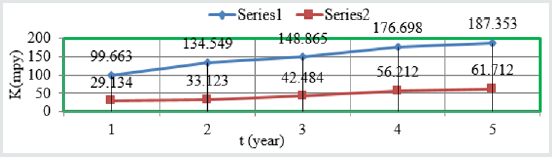
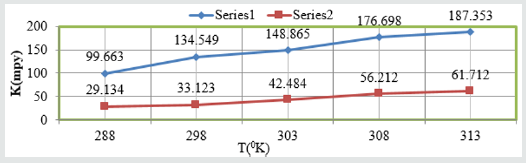
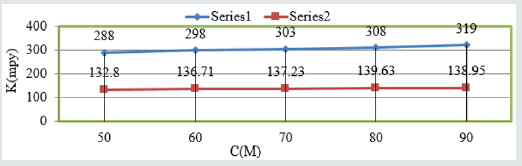
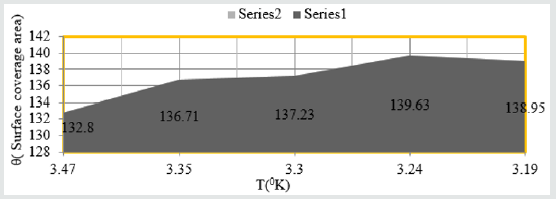
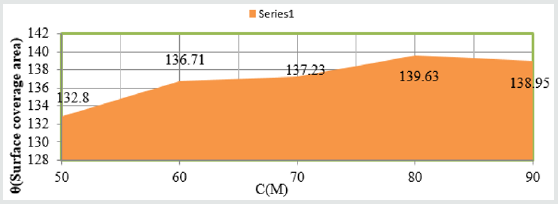
The corrosion rate of snails were determined by without and with Aloe Vera in mpy (miles per year) at different temperatures, concentrations and times in years by the use of formula K=534XΔW/D A t (where ΔW is weight loss in g, A is area in sq inch, t is immersion time in year). The dipping times were 1,2,3,4 and 5 years and temperatures are 288,298,303,308 and 3130K without inhibitors corrosion rate of snail is calculated and their values were recorded in Table 1. The addition of Aloe Vera in carbonic acid medium and corrosion rate of snail calculated at 288,298,303,308 and 3130K temperatures and 50, 60, 70, 80 and 90M concentrations and its values were mentioned in Table 1. It observed that without action of inhibitor corrosion rate of snail increased as duration of times and temperatures were increased and, but its values were decreased after addition of Aloe Vera such types of trends noticed in Figure 1 K Vs t, Figure 2 K Vs T and Figure 3 K Vs C. The surface coverage area and inhibitor efficiency were calculated by formula θ= (1-K/Ko) and %IE= (1-K/Ko) X100 (where Ko corrosion rate without inhibitor and K corrosion rate with inhibitor) and their values were given in Table 2. The surface coverage area and inhibitor efficiency were calculated by formula θ= (1-K/Ko) and their values were given in Table 2. The results of Table 2 were shown that surface coverage area and percentage inhibitors efficiency were enhanced when inhibitors added at different temperatures and concentrations as per year. Such types of trends were noticed in Figure 4 θ Vs T and Figure 5 θ Vs C.
Figure 1: K Vs t for snails at different years.
Lupinepublishers-openaccess-material-science-journal
Figure 2: K Vs T for snails at different tempertaures.
Lupinepublishers-openaccess-material-science-journal
Figure 3: K Vs C for snails at concentations.
Lupinepublishers-openaccess-material-science-journal
Figure 4: θ Vs T for snails in Aloe Vera.
Lupinepublishers-openaccess-material-science-journal
Figure 5: θ Vs C for snails in Aloe Vera.
Lupinepublishers-openaccess-material-science-journal
Table 1: Corrosion rate of snail absence and presence of Aloe Vera in H2CO3.

Lupinepublishers-openaccess-material-science-journal
Table 2: Surface coverage area develop by Aloe Vera on the snails in H2CO3.

Lupinepublishers-openaccess-material-science-journal
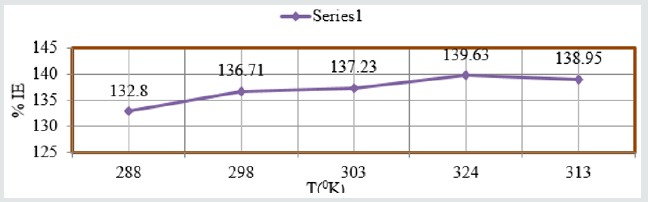
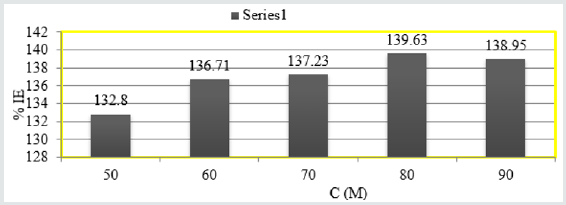
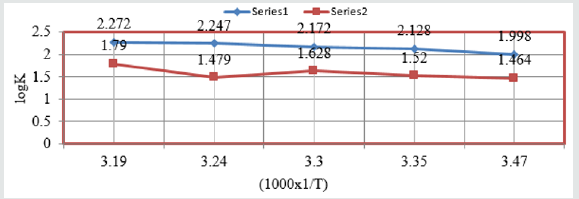
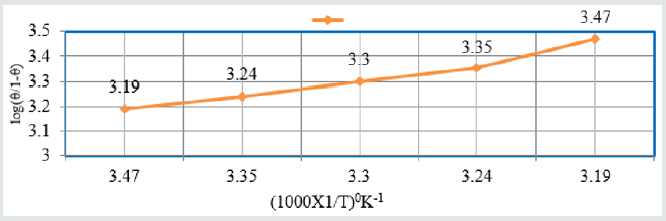
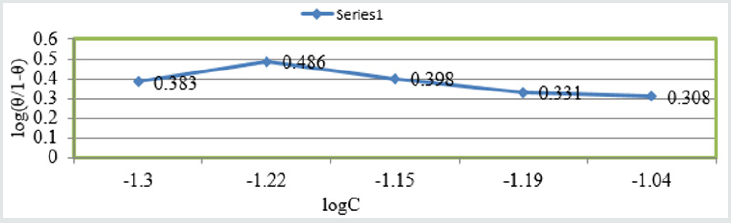
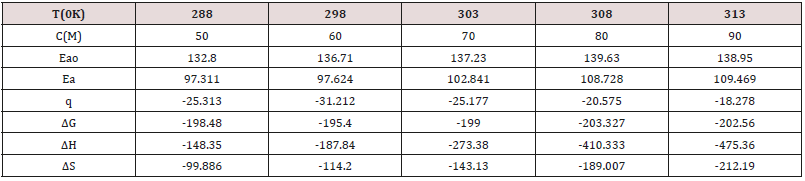
The percentage inhibitors of Aloe Vera at different temperatures and concentrations as one-year interval were calculated by %IE= (1-K/Ko) X100 (where Ko corrosion rate without inhibitor and K corrosion rate with inhibitor) and the values were written in Table 3. The results of Table 3 were depicted that percentage inhibitors efficiency were increased as temperatures and concentration were enhanced. Such types of trends also observed in Figure 6 %IE Vs T and Figure 7 %IE Vs C. Surface adsorption phenomenon was studied by activation energy, heat of adsorption, free energy, enthalpy and entropy. Activation energy was determined by formula K=A e-Ea/RT (where K is corrosion rate, Ea is activation energy and T is absolute temperature without and with action of Aloe Vera at different temperatures and concentrations and their values were recorded in Table 4. It observed that activation energy increased without inhibitors but its values decreased after addition of inhibitors. These results were shown in Table 4 which indicated that inhibitors adhered on snails by chemical bonding and their values were obtained by Figure 8 plotted logK Vs 1/T. Heat of adsorption values were found to be negative which indicated that Aloe Vera was shown an exothermic reaction in H2CO3 medium. It adsorbed on the surface of snail by chemical bonding. The values of heat of adsorption were determined by Langmuir isotherm log(θ/1-θ) = logA +logC-q/2.303RT and Figure 9 plotted log(θ/1-θ) Vs1/T and Figure10 plotted against log(θ/1-θ) Vs logC and their values were recorded in Table 4.
Figure 6: %IE Vs T for snails in Aloe Vera.
Lupinepublishers-openaccess-material-science-journal
Figure 7: %IE Vs C for snails in Aloe Vera.
Lupinepublishers-openaccess-material-science-journal
Figure 8: logK Vs 1/T for snails in Aloe Vera.
Lupinepublishers-openaccess-material-science-journal
Figure 9: log(θ/1-θ) Vs 1/T for snails in Aloe Vera.
Lupinepublishers-openaccess-material-science-journal
Figure 10: log(θ/1-θ) Vs logC for snails in Aloe Vera.
Lupinepublishers-openaccess-material-science-journal
Table 3: Inhibition efficiency develop by Aloe Vera in H2CO3.

Lupinepublishers-openaccess-material-science-journal
Table 4: Thermal parameters of Aloe Vera with Snails.
Lupinepublishers-openaccess-material-science-journal
Table 5: Potentiostatic results of snails for Aloe Vera.

Lupinepublishers-openaccess-material-science-journal
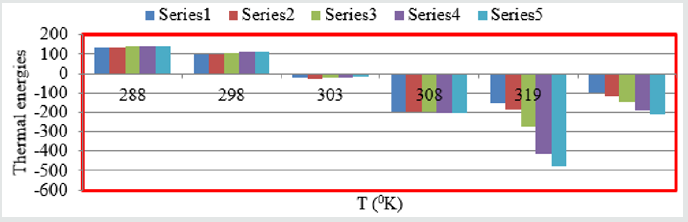
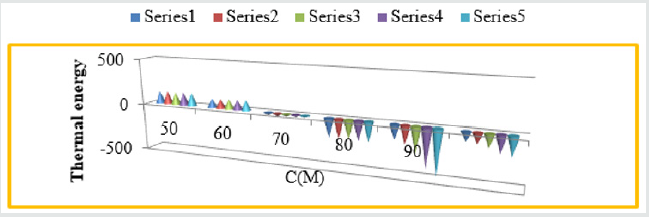
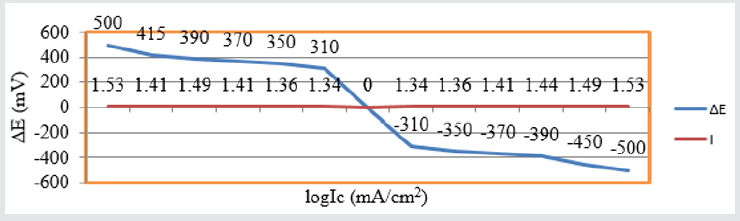
Free energy of inhibitor Aloe Vera was calculated by equation ΔG=2.303 log(33.3K) and their values were given in Table 4. Their values noticed that inhibitor action a chemical reaction because free energy values were negative, and their values mentioned in Table 4. Enthalpy of used inhibitors was determined by transition state equation K=RT/Nh eΔS/R e-ΔH/RT and its values were recorded in Table 4. These values indicated that inhibitor’s Aloe Vera boned with snail by chemical bonding. Entropy of Aloe Vera was determined by equation by ΔG = ΔH – TΔS and their values were mentioned in Table 4. Their values were shown that deposition of Aloe Vera on the surface of snail was an exothermic process. It formed stable barrier on the surface of snail. All five values of thermal parameters plotted against T in Figure 11 and Figure 12 against C. The corrosion potential, corrosion current density and corrosion rate were determined by the equation ΔE/I=1/2.303 βaβc/(βa+βc) and C R(mpy)=0.1288 Ic (mA/cm2) XE/ρ and values were recorded in Table 5. It observed that without inhibitor corrosion potential and corrosion current were decreased but after addition of Aloe Vera corrosion current densities were increased. It also reduced the corrosion potential and corrosion current. The corrosion rate calculated by potentiostat technique and their values were tallied with the corrosion rate determined by gravimetric method. Corrosion potential versus corrosion current density was plotted in Figure 13. This plot indicated that anodic current reduced as addition of inhibitor but cathodic current enhanced Table 5.
Figure 11: Themal energies Vs T for Aloe Vera with Snails.
Lupinepublishers-openaccess-material-science-journal
Figure 12: Thermal energies Vs C for Aloe Vera with snails.
Lupinepublishers-openaccess-material-science-journal
Figure 13: ΔE Vs Ic for snails with Aloe Vera.
Lupinepublishers-openaccess-material-science-journal

Conclusion

Snails’ corrosion occurs due to change the pH of water. Water pH is altered by contamination effluents, industrial polluters, and various types of wastes and acids rain. Snails outer layers are constructed by calcium carbonate. In acidic medium calcification starts on their surface by chemical process. It produces pitting, stress and crevice corrosion. For the protection of such types corrosion Aloe Vera is used as inhibitors. Aloe Vera forms thin film on the surface of snails. The thin film formation is confirmed by thermal parameters like activation energy, heat of adsorption, free energy, enthalpy and entropy. Aloe Vera surface adsorption phenomenon on snails is also satisfied by Langmuir isotherm. Aloe Vera is reduced the concentration of H+ ions and enhance the concentration of oxygen molecules. It is nitrogen containing rich organic compounds which capture H+ ions and less H2 gas is released thus corroding effect of snails suppressed.

Acknowledgment

Author is thankful for UGC-New Delhi, India for providing financial support for this work. I also thank my research team for their collection of data and graph plotting. I am very grateful professor G Udhayabhanu IITD and professor Sanjoy Misra providing laboratory facility.

Read More Lupine Publishers Material Journal Articles : https://lupine-publishers-material.blogspot.com/
Read More Lupine Publishers blogger Articles : https://lupinepublishers.blogspot.com

Monday, April 22, 2019

Surface engineering_Lupine publishers

Fatigue Crack Initiation in AA3004 At Elevated Temperature Using Rotating and Bending Fatigue Testing Machine

The numerous failures in engineering applications occur due to fatigue, therefore, design against fatigue failure is crucial and particularly fatigue failure of engineering applications having notches or holes because almost all applications have such type of discontinuities. Once the crack initiates it is very difficult to stop it, therefore, crack initiation in different materials is vital to be designed. This work is also related to the design of crack initiation in AA 3004 aluminum alloy at elevated temperature by means rotating and bending fatigue testing machine. A favorable working temperature environment has been set by means of the 1000W electric rod.

https://lupinepublishers.com/material-science-journal/fulltext/fatigue-crack-initiation-in-aa3004-at-elevated-temperature-using-rotating-and-bending-fatigue-testing-machine.ID.000108.

For more Lupine Publishers Open Access Journals Please visit our website: http://www.lupinepublishers.com

For more Open Access Journal articles Please Click Here:
https://lupinepublishers.com/material-science-journal/archive.php


Monday, April 1, 2019

Enivironmental Materials_Lupine Publishers


Effect of Laser Welding Parameters on Porosity of Welds in Cast Magnesium Alloy AM50


Magnesium alloys are light-weight metals suitable for applications in several industries, such as automotive and aerospace. Compared with most materials they provide a possibility to reduce weight due to their high specific strength. However, their tensile strength is low (190-310MPa) compared with steels, which may limit their application; for example, to car interior parts such as seat frames, steering wheels or structural dashboard cross beams [1-4]. A common magnesium alloy is AM50 (4.4-5.5 wt% Al, 0.26-0.6 wt% Mn) which, compared with other magnesium alloys, is of relatively high strength, high hardness, high elongation and has excellent castability. Often magnesium alloys are cast into complex shapes using high pressure die-casting [5-8]. An alternative is to cast less complicated parts and join them by welding, commonly by tungsten inert gas (TIG) or metal inert gas (MIG) welding [2].
https://lupinepublishers.com/material-science-journal/fulltext/effect-of-laser-welding-parameters-on-porosity-of-welds-in-cast-magnesium-alloy-am50.ID.000106.php

For more Lupine Publishers Open Access Journals Please visit our website: http://www.lupinepublishers.com/


For more Polymers Journal Articles Please Click Here:
 https://lupinepublishers.com/material-science-journal/

Friday, March 22, 2019

Composite Materials- Lupine Publishers


New Advances in Environmental Friendly Materials by Aloe Vera in Modern Approaches on Material Science in Lupine Publisher

This last decade has been characterized by the acquisition of new materials based on the biomass, with the objective of replacing the materials obtained from petroleum derivatives, due to the high costs, added to the fact that they are non-renewable inputs and as a measure of the preservation of the environment [1]. In all areas of study has been this responsibility of searching for new and versatile materials. Packaging, medical materials, agro-industry.

For more Lupine Publishers Open Access Journals Please visit our website: http://www.lupinepublishers.com/

For more Composite Materials Please Click Here: https://lupinepublishers.com/material-science-journal/

Friday, March 15, 2019

Polymers_ Lupine Publishers

Corrosion of Snails in H2CO3 Medium and Their Protection by Aloe Vera in Modern Approaches on Material Science in Lupine Publishers

Snails are beautiful creation of nature. They occur in rivers as well as ponds. But these sources of water are contaminated by effluents, pollutants, acid rain, particulates, biological wastes etc. They can change the pH of water. Water is absorber of carbon dioxide and it converts carbon dioxide into carbonic. Other above-mentioned wastes also increase the concentration of H+ ions in water. They produce hostile environment for snails. The outer part of snails is made of CaCO3. It produces chemical reaction in acidic medium and corrosion reaction is accelerated thus deterioration starts on the surface of snails. This medium their survival becomes miserable.

https://lupinepublishers.com/material-science-journal/fulltext/corrosion-of-snails-in-h2co3-medium-and-their-protection-by-aloe-vera.ID.000104.php


For more Lupine Publishers Open Access Journals Please visit our website: http://www.lupinepublishers.com/


For more Polymers Journal Articles Please Click Here:
 https://lupinepublishers.com/material-science-journal/


Friday, February 22, 2019

Nano Materials- Lupine Publishers


Groups 4 and 15 and Organotin Condensation Polymers for The Treatment of Cancers and Viruses in Modern Approaches on Material Science in Lupine Publishers
 
This short review describes the use of group 4 metallocenes, group 15 organometallics and organotin polymers in the treatment of human cancer tumors and viruses. These metal-containing polymers show good inhibition of all the main group solid tumors including pancreatic, lung, brain, breast, prostate and colon human cell lines. They also show inhibition of a variety of viruses including zika, herpes and vaccinia viruses. Synthesis of the polymers is rapid employing interfacial polymerization and commercially available reactants. They offer physicians a new class of drugs for the treatment of a variety of cancers and viruses.


For more Lupine Publishers Open Access Journals Please visit our website: http://www.lupinepublishers.com/


For more Nano Materials Journal Articles Please Click Here:
https://lupinepublishers.com/material-science-journal/


Tuesday, February 5, 2019

Semiconductors- Lupine Publishers


Palm Oil Fuel Ash as A Cement Replacement in Concrete by Jonida Pone in Modern Approaches On Material Science in Lupine Publishers

To produce concrete, cement is an essential material that binds together solid bodies but also is the largest producer of carbon dioxide (CO2) emission. Up to 10% of global CO2 emission comes from cement production thus making the sustainability of concrete a major issue that needs addressing. The processes of producing concrete consume heavily on natural resources such as sand, gravel, water, coal and crushed rock, mining of which damages the environment. It is however possible, that energy and cost efficiency can be achieved by reducing on the amount of clinker, and in its place utilizing partial cement replacements/pozzolans that require less process heating and emit fewer levels of carbon dioxide. This study investigates the effectiveness of agro waste ash by-product Palm Oil Fuel Ash (POFA) as an alternative material to replace Portland cement (OPC). Experiments were carried out by supplementing CEM I cement by weight in concrete mixes with POFA at 2.5%, 5%, 10%, 15% and 20% steps at the point of need, with water to cement ratio of 0.5. Results were compared with a control specimen, which was made with 100% cement. The results showed impressive compressive strength, especially at early age; in fact POFA specimens containing 2.5% and 5% POFA replacement displayed greater early compressive strength in comparison to the control, which is similar in behaviour to concrete containing silica fume which is an established partial cement replacement used in high strength applications. The results showed good repeatability and highlight the potential of POFA as an effective pozzolan which could enhance the sustainability and economic aspect of concrete.

https://lupinepublishers.com/material-science-journal/fulltext/palm-oil-fuel-ash-as-a-cement-replacement-in-concrete.ID.000102.php

For more Lupine Publishers Open Access Journals Please visit our website: http://www.lupinepublishers.com/

For more Semiconductors Journal Articles Please Click Here:
 https://lupinepublishers.com/material-science-journal/


Tuesday, January 29, 2019

Journal Of Material Science | Lupine Publishers

New Materials: Current Development Under Simulation Techniques

By : Efrén Vázquez Silva*.


Abstract

In the present short communication, a point of view on the contemporary tendencies in the development of the Science of Materials is offered. And for this, the main lines of research (personal criteria) in this area are considered, linked to problems of great importance for humanity: the care and preservation of the environment, renewable sources of energy and the health of people.


Read More About This Article : Full Text  : https://lupinepublishers.com/material-science-journal/fulltext/new-materials-current-development-under-simulation-techniques.ID.000101.php

For more Lupine Publishers Open Access Journals Please visit our website: http://www.lupinepublishers.com/ 

For more Journal Of Material Science articles Please Click here:  https://lupinepublishers.com/material-science-journal


Happy Thanksgiving 2022!!!

                      Thanksgiving is a joyous invitation to shower the world with love and gratitude. Forever on Thanksgiving the heart wil...